

Every coil on target: fewer rejects, less wasted wire, no manual measuring.
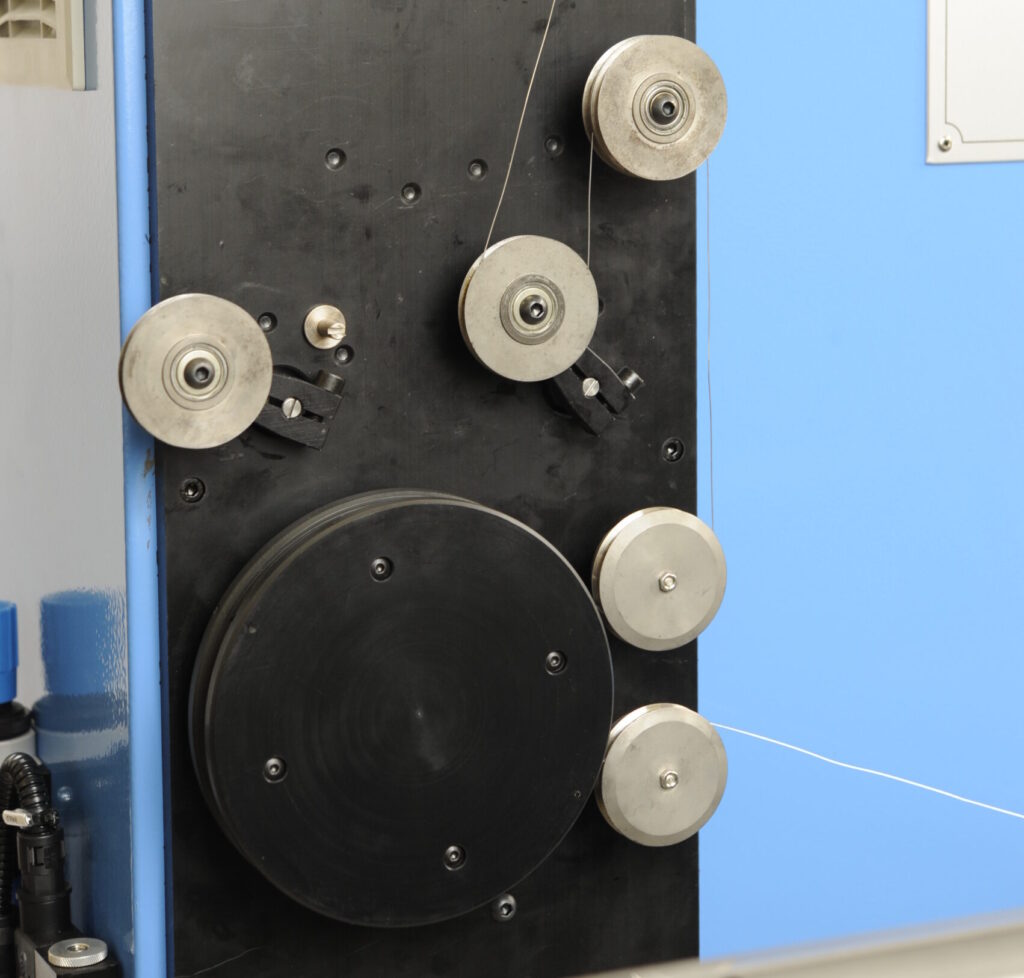
When you make resistance coils for heating elements, open coils or kilns, the number that matters is the ohm value of the finished coil. Most coil winding machines get there indirectly: they track how much wire has gone by and multiply it by the wire’s nominal resistance per unit of length. Our coil winder measures the actual resistance of the wire while it winds.
Why length is only a stand-in
Resistivity is never perfectly uniform along a spool. Two things usually get in the way:
- Isolated defects: nicks or flaws from the wire-making process can cause a sudden resistance spike at a single point.
- Gradual drift: the ohm value shifts slowly from the start of the spool to the end. It often stays within tolerance, but it is never truly constant.
A machine that counts length can’t see either one. It keeps winding on an assumption, and the operator ends up readjusting length settings by hand.
How real-time measurement works
Our coil winder continuously reads the real resistance of the wire as it winds, so it can react to both situations:
- Sudden jump: if resistance leaves the tolerance band the operator has set, the machine stops before an out-of-spec coil is produced.
- Slow drift: the machine compensates on its own, using a little more or less wire to hold the target ohm value.
You get the ohms you asked for, even when the wire changes along the spool.
What it means on your production floor
- The right ohm value, without manual checks. Operators no longer need to measure coils after winding, whether you spot-check or test every coil. That is a lot of operator time saved.
- Fewer rejects, less scrap. The machine stops at the problem instead of letting quality control find it downstream. And since each coil is wound to the exact ohm value, it never uses more wire than needed.
- Reliable data for quality records. Resistance is measured, not calculated, so the numbers you document are more dependable.
Grow your output, not your costs
Our coil winder handles 13 to 34 gauge wire and coils up to 0.630″ (16 mm) in diameter, from 1 to 4 wires. It keeps running even when unattended, and stops by itself if the wire breaks, bunches up or drifts out of tolerance. Two versions let you match the machine to your range, so you can scale up without changing your process.